IntegralDots PayConnect Payment integration suite
Instant, bulk and biller payments between your payment hub and your core, ISO 20022 native.
PayConnect sits between your payment hub and core banking. It holds funds before a payment leaves, posts exactly once when the rail confirms, and releases the hold when it does not. SARIE and IPS instant payments, bulk files and SADAD-style biller services all run through the same controlled lifecycle, and every message can be traced.
- RailsSARIE, IPS, bulk files, SADAD-style billers
- MessagesISO 20022 pacs, pain and camt
- PostingFunds held first, posted once on confirmation
- Built forBanks connecting payment hubs to core banking
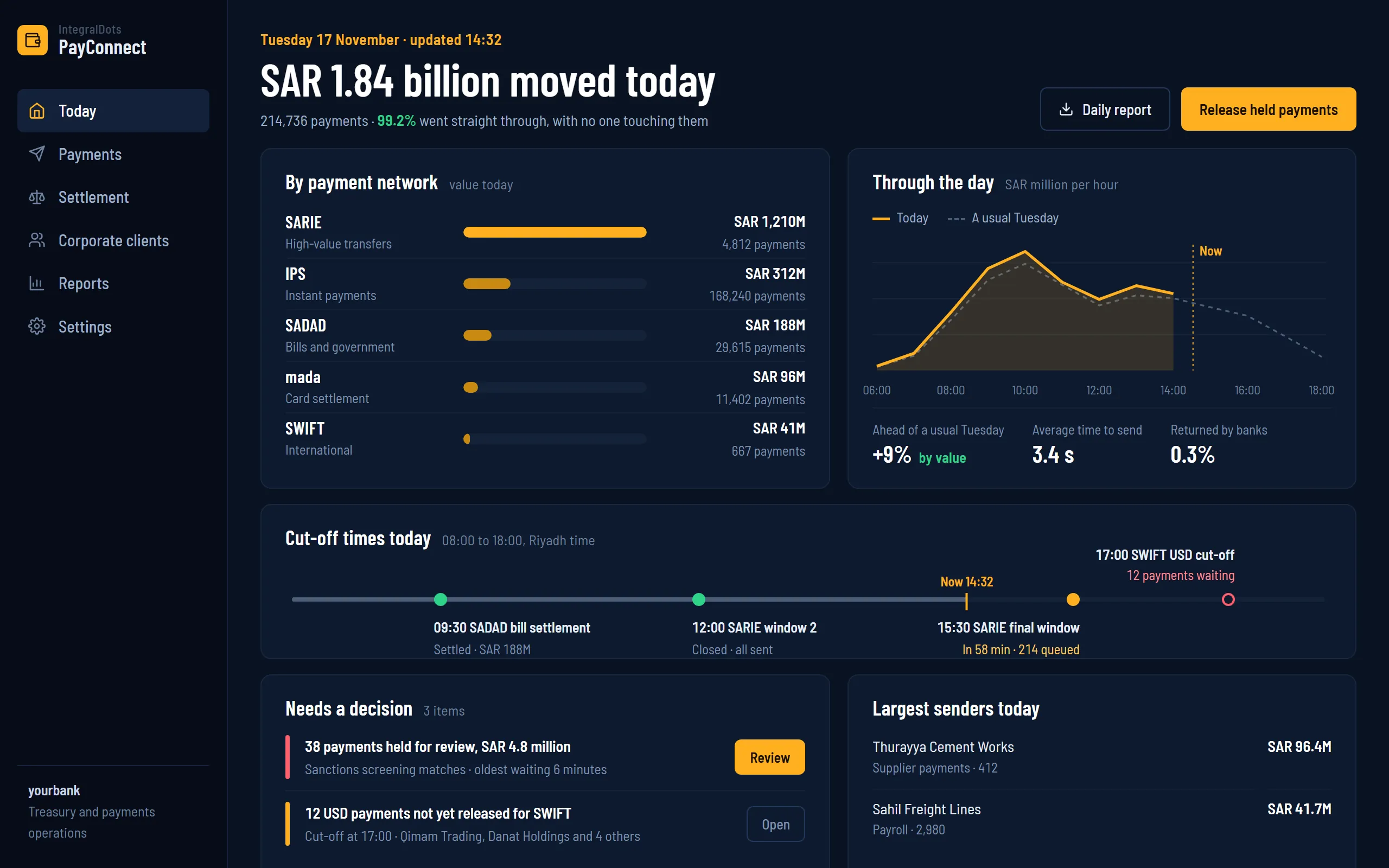
- By payment networkValue and number of payments on SARIE, IPS, SADAD, mada and SWIFT today. SARIE carries SAR 1,210 million of the SAR 1.84 billion.
- Through the dayValue per hour against a usual Tuesday. Today is 9% ahead by value, a payment takes 3.4 seconds on average and 0.3% came back from other banks.
- Cut-off timesSADAD and the second SARIE window are done. The final SARIE window closes at 15:30 with 214 payments queued, and 12 USD payments wait for the 17:00 SWIFT cut-off.
- Needs a decision38 payments worth SAR 4.8 million held by sanctions screening, and the USD payments not yet released, each with the button that opens it.
Product screens show demo data.
Most payment incidents start at the hand-offs between channel, hub, core and rail.
A payment passes through a channel, the payment hub, the core and the rail before it is final. Every hand-off can time out, be retried or answer late. Without one layer that owns the whole lifecycle, banks get double postings, stuck holds and end-of-day spreadsheets.
- Double postingsA timeout followed by a retry posts the same payment twice, and someone reverses it by hand.
- Stuck holdsA payment fails on the rail but the funds stay held, and the customer calls before operations notice.
- Blind spotsNobody can say quickly where a payment is between the channel, the hub, the core and the rail.
- Files that don't balanceBulk and payroll files are reconciled after the fact, in spreadsheets, at the end of the day.
One lifecycle for every payment.
In PayConnect, instant, high-value, bulk and biller payments follow the same five steps. Each step is recorded, so any payment can be traced from the first request to the final posting.
Receive
Channels call one API, over REST or a legacy format. Each request carries an idempotency key, so a retry never creates a second payment.
Verify and hold
Limits and the balance are checked on the core and the amount is held. Fees are calculated before anything leaves the bank.
Send
PayConnect builds the ISO 20022 pacs.008 and hands it to your payment hub for IPS or SARIE.
Confirm
The pacs.002 status decides the next step. A rejection releases the hold. Returns (pacs.004) and cancellations (camt.056, camt.029) follow their own paths.
Post and reconcile
Confirmed payments post once on the core, the hold is released and events are published. Every item is then matched across core, hub and rail.
The controls a payment layer needs.
pacs message orchestration
Builds and reads pacs.008, pacs.002, pacs.004 and pacs.028, and carries the UETR and end-to-end ID from channel to core. camt.056 and camt.029 handle cancellations.
Verify, hold, post, release
Funds are held before sending and posted once on a confirmed status. Rejections, timeouts and returns release or reverse the hold.
Idempotency and replay safety
Keys are kept for 24 hours. A repeated request returns the original result; the same key with a different body is refused.
Circuit breakers and backoff
Each core and rail dependency has its own breaker. Retries use exponential backoff with jitter, and only on calls that are safe to repeat.
One routing layer, modern and legacy
Mobile, internet banking, corporate portals, open banking and host-to-host files reach the same lifecycle through REST APIs or legacy message and file formats.
Bulk, payroll and biller files
Control totals checked before any debit, item-level status, and three-way reconciliation of core postings, hub messages and rail settlement.
Built for payment operations and the people they report to.
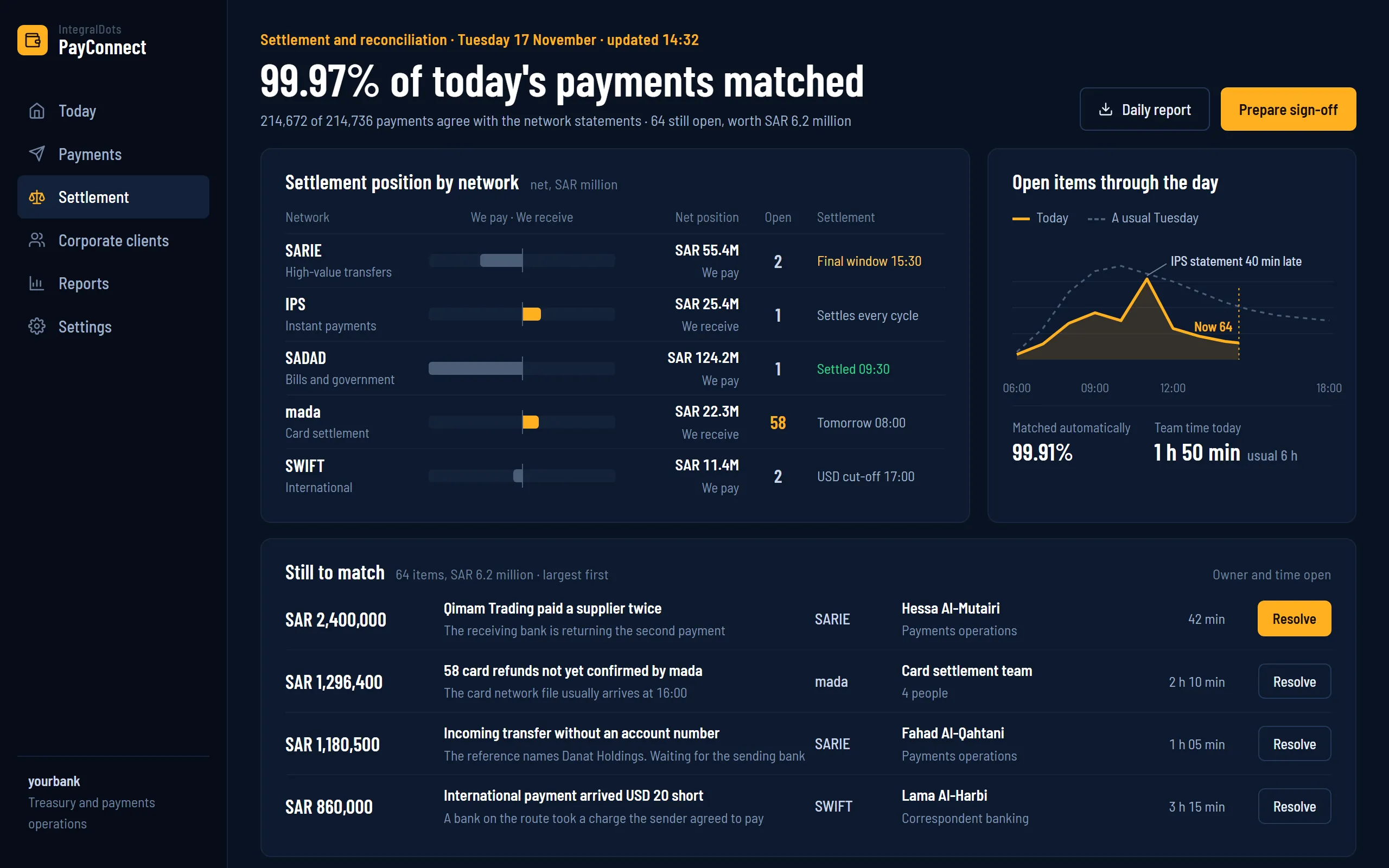
Settlement and reconciliation on one page
PayConnect matches every payment against the statement from each network as it arrives. The team sees the share matched, what each network owes the bank or is owed, and the few items still open, each with an owner.
- Share matched214,672 of 214,736 payments agree with the network statements. The 64 still open are worth SAR 6.2 million.
- Position by networkThe net amount the bank pays or receives on each network, the items still open and when it settles. SADAD settled at 09:30 and the SARIE final window is at 15:30.
- Through the dayOpen items by hour against a usual Tuesday, with the late IPS statement marked. 99.91% matched automatically, and the team spent 1 hour 50 minutes on the rest against about 6 hours usually.
- Still to matchThe largest open items, each with its amount and the reason in plain words, such as a supplier paid twice or a transfer that arrived without an account number.
- Owner and actionEvery item shows its owner and how long it has been open. Resolve opens the payment with its history.
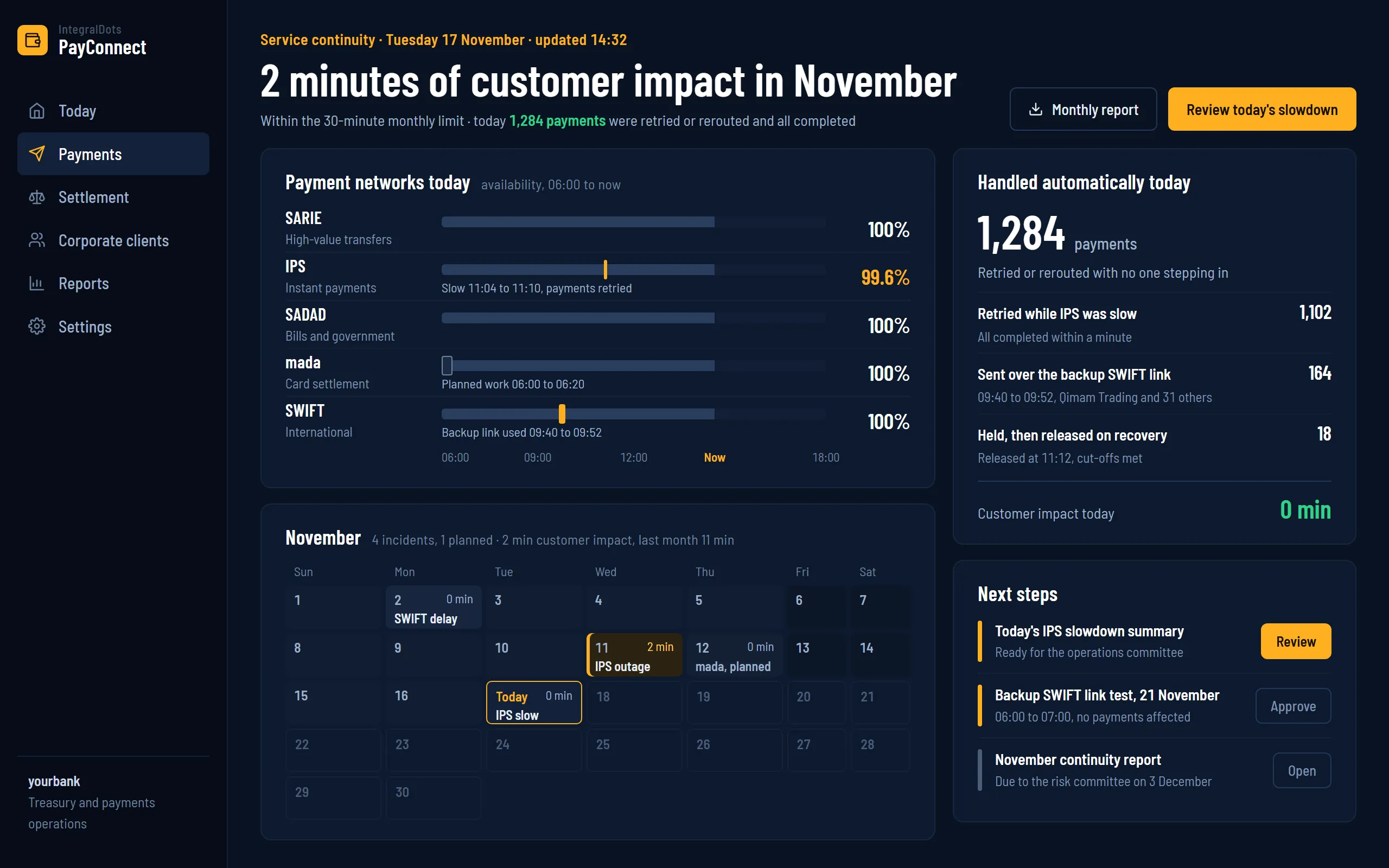
Service continuity, counted in customer minutes
When a payment network slows down or drops, PayConnect retries, reroutes or holds payments on its own. This page shows what happened today, what customers noticed and how the month compares with its limit.
- Networks todayAvailability of each payment network since 06:00. IPS was slow from 11:04 to 11:10, mada had planned work and SWIFT used the backup link for 12 minutes.
- Month viewEvery incident in November by day, with its customer impact in minutes. The IPS outage on 11 November is the only one customers noticed.
- Handled automatically1,284 payments were retried, sent over the backup link or held and released today. All of them completed within their cut-off.
- Customer impactMinutes in which customers saw a failed or delayed payment: none today, and 2 so far this month.
- Next stepsToday's slowdown summary for the operations committee, the backup SWIFT link test to approve and the monthly continuity report.
Runs inside your payment perimeter.
Deployed next to your payment hub and core, under your controls, your keys and your change process.
Deployment
- Your data centre or private cloud tenancy
- High-availability setup across your data centres
- Runs on your container platform or virtual machines
- Health checks, metrics and alerts into your monitoring
Security
- Mutual TLS between channels, PayConnect, the hub and the core
- OAuth 2.0 for channel APIs, with scopes per channel
- Keys and certificates kept in your HSM or key vault
- Account numbers masked on screens and in logs
Governance
- Every message, status change and operator action logged with timestamps
- Maker-checker for overrides, manual releases and re-posts
- Resilience and routing policies versioned and approved before use
- Retention that follows your records policy
Integration
- ISO 20022 pacs, pain and camt messages through your payment hub
- Core banking adapters for balance, hold, posting and fees
- REST and SOAP channels, and SFTP host-to-host files
- Payment events to your event bus or notification platform
- ISO 20022
- SAMA Cyber Security Framework controls
- PDPL data handling
- OAuth 2.0 and mutual TLS
- OpenAPI
Questions payment leaders ask
Does PayConnect replace our payment hub?
No. Your hub keeps its connections to SARIE and IPS. PayConnect sits between the hub and your core: it owns verify-and-hold, posting, fees, events and reconciliation, and exchanges ISO 20022 messages with the hub.
How do you stop a payment from posting twice?
Every financial call carries an idempotency key, kept for 24 hours. A retry with the same key returns the first result instead of posting again, and a different payload under the same key is refused. Posting happens once, on a confirmed status.
What happens when the core is slow or down?
The breaker for that operation opens and calls fail fast instead of piling up. Funds already held stay held and postings wait in order. Once the core recovers, trial calls bring traffic back gradually.
How are returns and cancellations handled?
A pacs.004 return is matched to the original payment and credited back to the debtor. Cancellation requests go out as camt.056, and the camt.029 answer closes the case either way.
Which core banking systems does it work with?
PayConnect talks to your core through an adapter for balance, hold, posting and fee services. The adapter is built and tested against your core during implementation, so the payment lifecycle above it stays the same.
Related products
 Payments
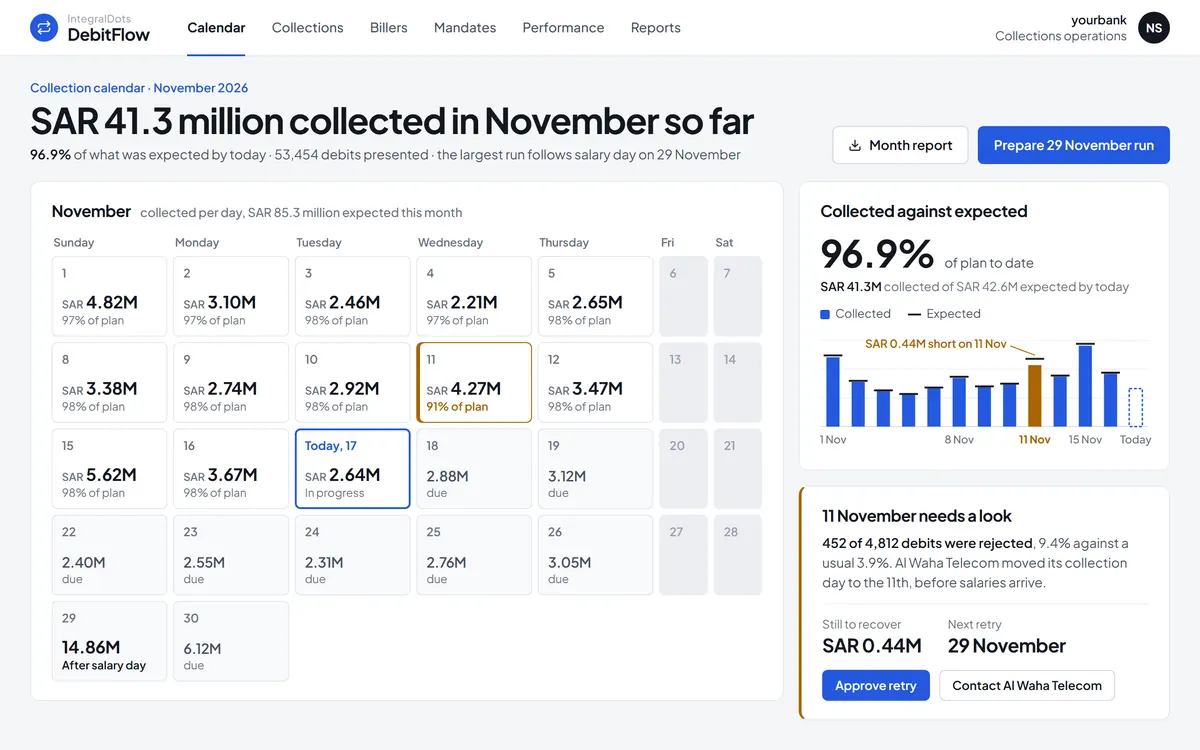
DebitFlow Direct debit collections
Recurring collections for your corporate clients, as a signed and documented API.
Explore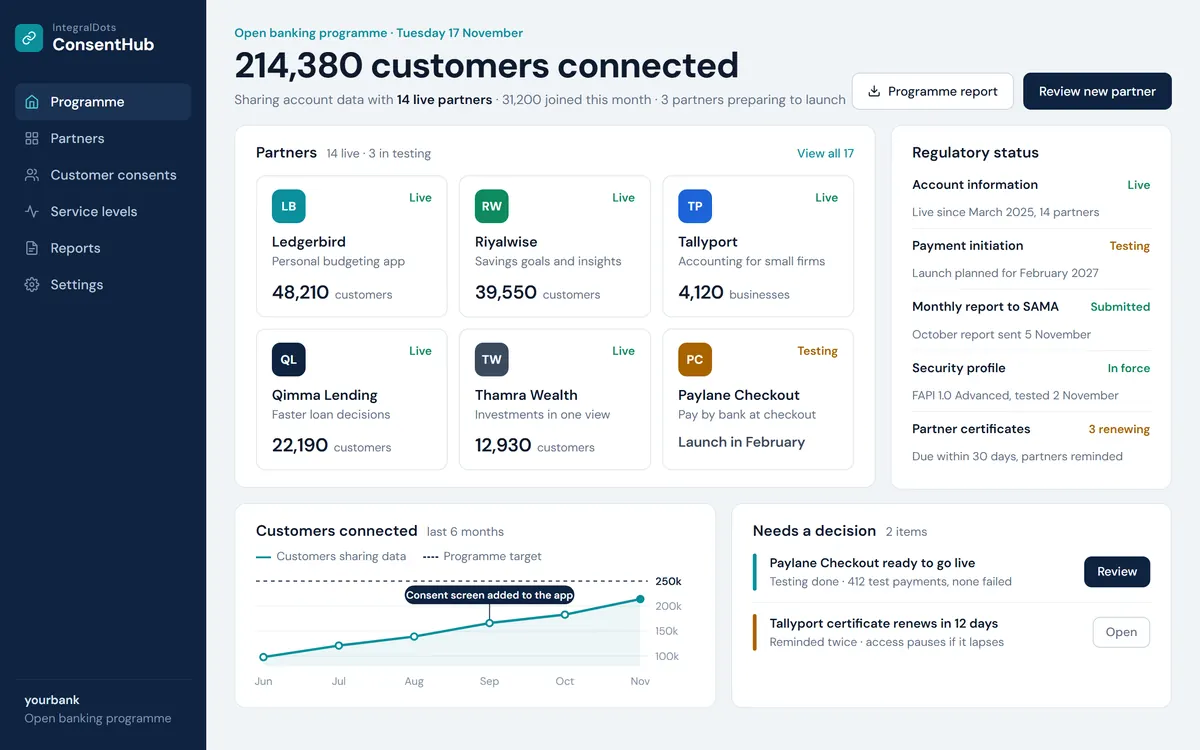 Open finance
ConsentHub Open banking platform
Consent, third-party onboarding, and account and payment APIs for the KSA Open Banking Framework.
Explore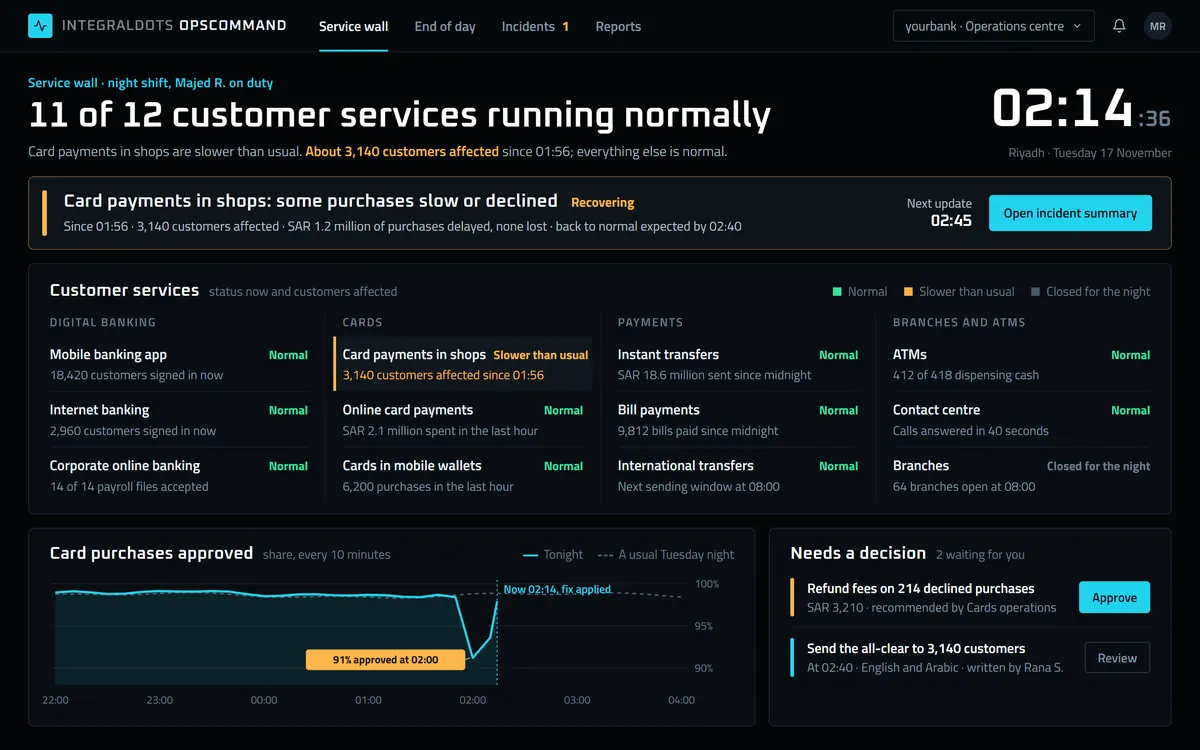 Operations
OpsCommand Operations command center
Every platform, queue and batch job on one wall, with the workflow to act on it.
Explore