IntegralDots OneSign Customer identity and access (CIAM)
One customer identity for every channel, with risk-based security built in.
OneSign signs customers in across mobile, web, call centre and partner channels with a single identity. It weighs device, location and fraud signals on every sign-in and sensitive action, asks for more proof only when the risk calls for it, and federates with Nafath where you need national identity assurance. The same token service secures your open banking APIs.
- FederationNafath and OpenID Connect
- AuthenticationPasskeys, app biometrics, Nafath step-up
- PrivacyConsent records aligned with PDPL
- TokensFAPI-grade, shared with open banking
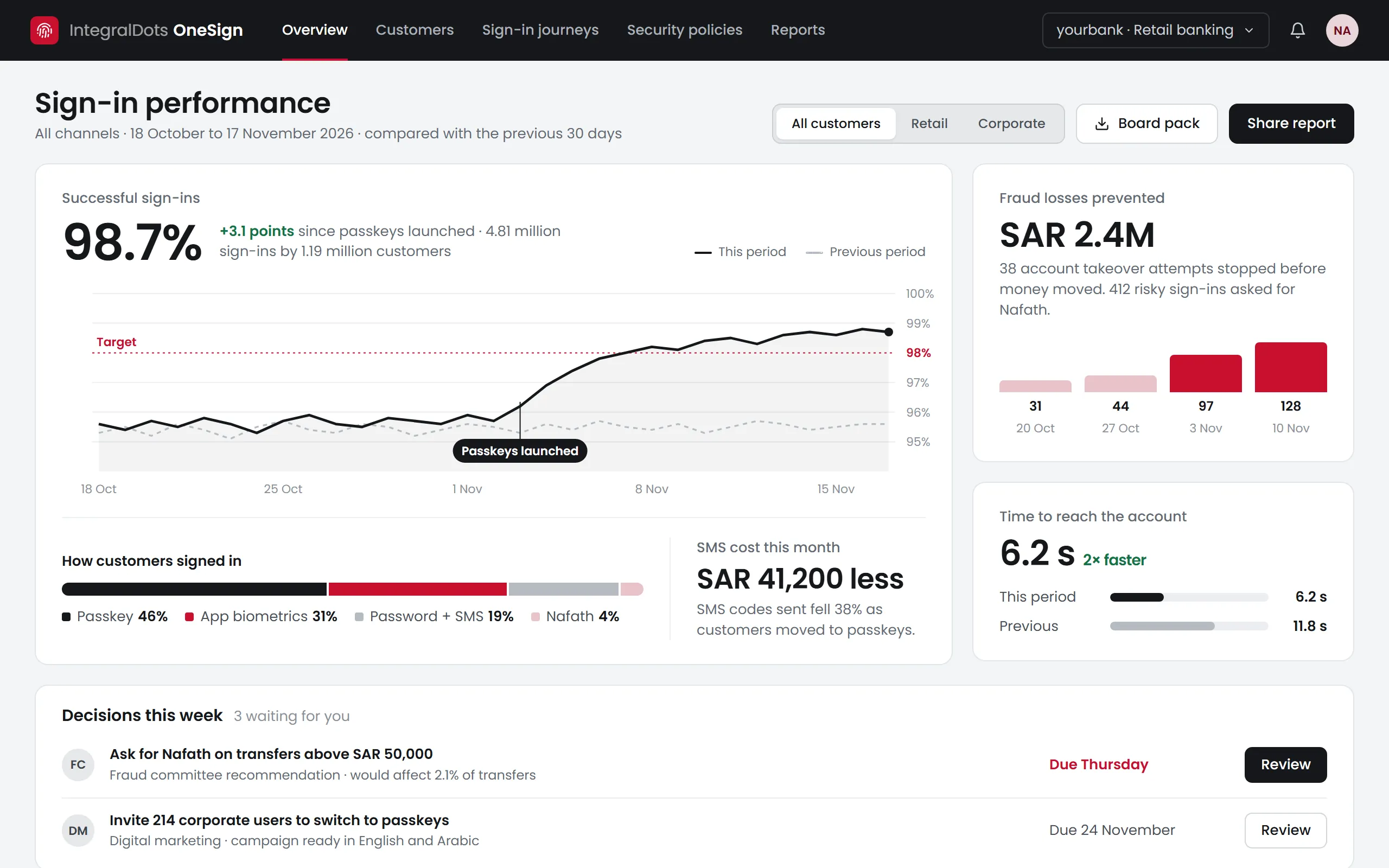
- Successful sign-insThe share of sign-ins that succeed, against the previous 30 days and your target, with the passkey launch marked.
- How customers sign inPasskeys, app biometrics, password with SMS and Nafath, and the SMS cost saved as customers move.
- Fraud preventedMoney protected this month, takeover attempts stopped and risky sign-ins sent to Nafath.
- Decisions this weekPolicy changes and campaigns waiting for approval, with who raised them and when they are due.
Product screens show demo data.
Most banks run several login systems, and none of them sees the whole customer.
Mobile, web banking, corporate portals, the call centre and now open banking each grew their own login. Customers repeat themselves, security teams tune rules in several places, and fraud moves to whichever channel is weakest.
- Fragmented loginsSeparate credentials and sessions per channel, and no single place to see or revoke them.
- One-size MFAAn OTP on every login frustrates good customers and still does not stop account takeover.
- Unused signalsDevice, location and fraud data exist in the bank, but sign-in decisions do not use them.
- Privacy on paperConsents and data-subject requests under PDPL are tracked in spreadsheets outside the identity system.
The right amount of proof for each moment.
The same five steps run for a login, a new payee, a large transfer or an open banking consent. Your policies decide how much proof each one needs.
Identify
The customer starts on any channel. Known devices are recognised; a new device is bound only after strong verification, such as Nafath.
Assess
Each sign-in and sensitive action is scored from device, network, location, behaviour and your fraud engine's verdict.
Authenticate
Low risk passes with a passkey or app biometric. Medium risk steps up to Nafath or in-app approval. High risk is blocked and flagged.
Issue
One session and sender-constrained tokens serve the app, web banking, partner channels and open banking consents.
Govern
Policies, consents and every decision are versioned and logged, ready for audit and for data-subject requests.
One identity layer for customers, channels and APIs.
Nafath and national digital identity
Nafath for onboarding, device binding, account recovery and step-up, with the result tied to the customer's verified national identity.
Adaptive, risk-based MFA
Passkeys, in-app biometrics with device-bound keys, Nafath and OTP as a fallback, chosen for each action by its risk, whatever the channel.
One identity across channels
OpenID Connect sessions across mobile, web, corporate and partner channels, with central sign-out and session revocation.
FAPI-grade token security
The same authorisation server issues sender-constrained tokens for your apps and your open banking APIs: FAPI 1.0 Advanced today, ready for 2.0.
Consent and privacy aligned with PDPL
Consent recorded per purpose, versioned privacy notices, and requests for access, correction and deletion tracked to completion.
Fraud and device signals
Device intelligence, IP reputation, geo-velocity and your fraud engine's scores feed every decision, and the outcomes flow back to the fraud team.
Built for the people who protect customer accounts.
One customer, in plain words
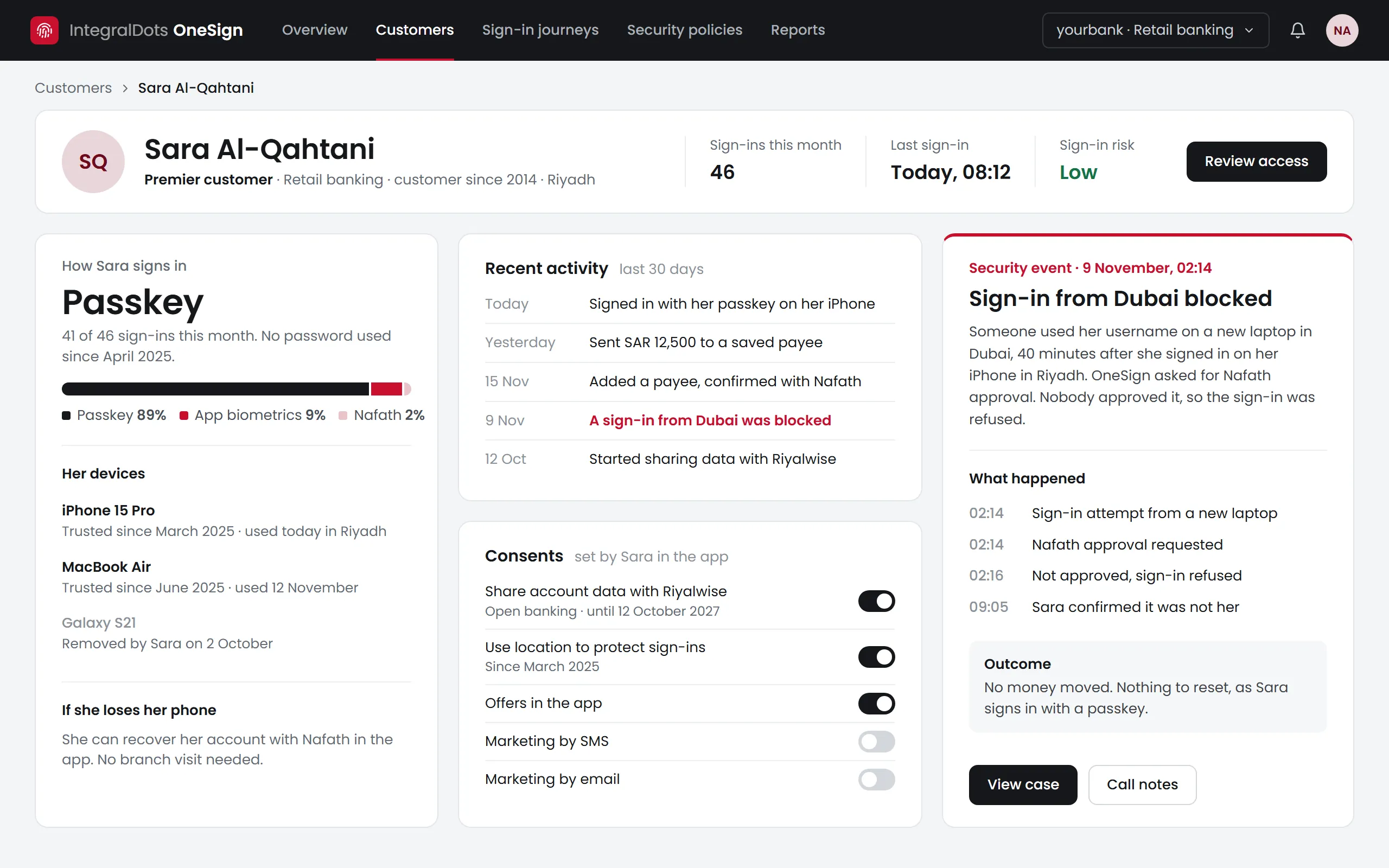
Service and fraud teams see who the customer is, how they sign in, what they have agreed to and what happened when something looked wrong.
- Customer and segmentName, segment, how long they have banked with you and their sign-in risk today.
- How they sign inTheir usual method, their trusted devices and how they recover access if a phone is lost.
- Recent activitySign-ins, payments and new payees, written as sentences.
- ConsentsOpen banking sharing, location and marketing choices, as the customer set them in the app.
- A security event explainedWhat happened, when, what OneSign did and the outcome, with the case one click away.
How strict sign-in should be, as a business decision
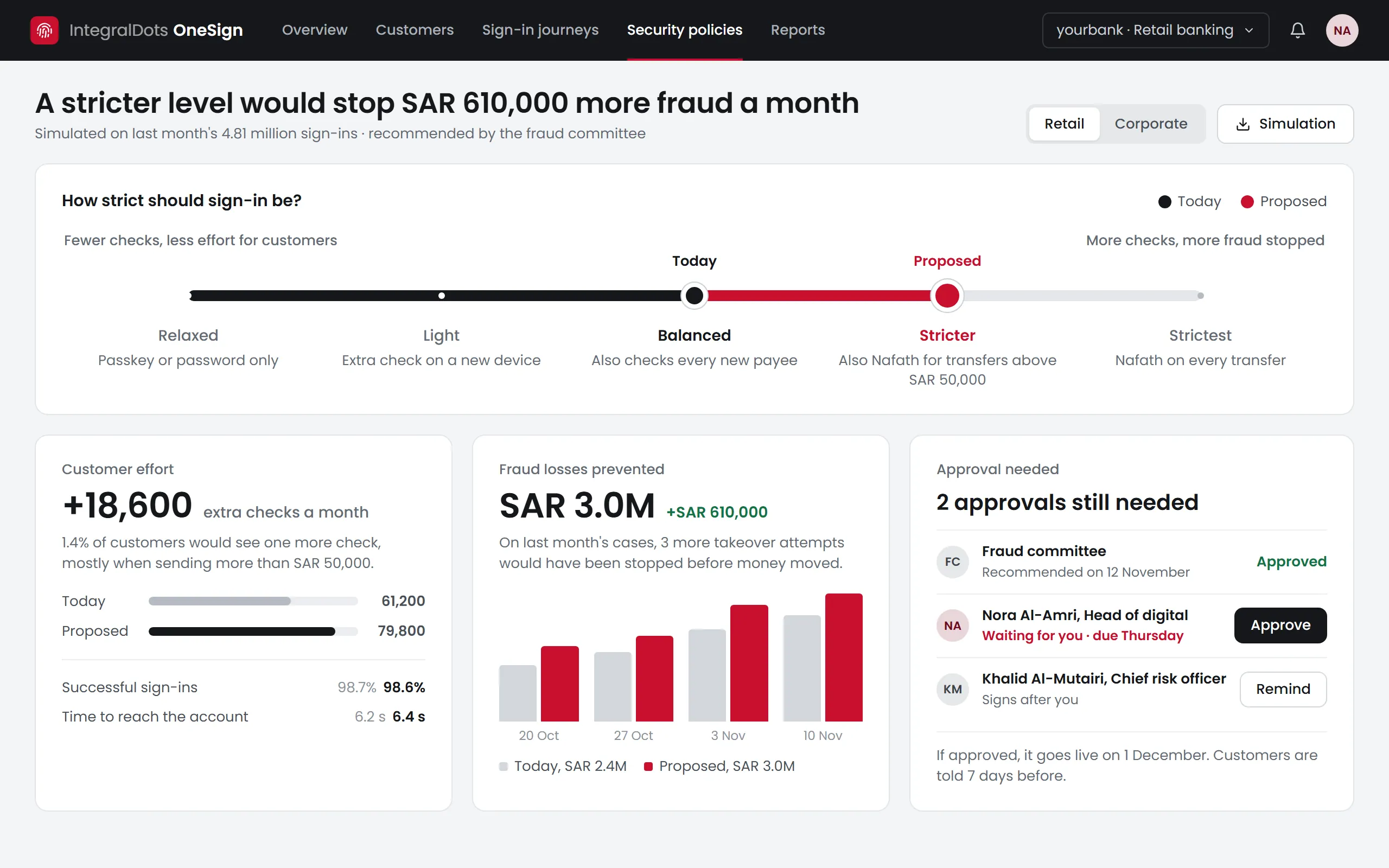
Fraud and digital leaders weigh the extra effort for customers against the fraud a stricter level would stop, simulated on last month's sign-ins, and approve the change together.
- From fewer checks to more checksFive levels, from a passkey or password alone to Nafath on every transfer, with today's level and the proposed one marked.
- Customer effortExtra checks a month and the share of customers affected, with the effect on successful sign-ins.
- Fraud preventedLosses that would have been stopped, week by week, simulated on last month's cases.
- Approval neededWho has approved, who is next and when the change would go live.
Customer identity stays inside your boundary.
Built for a regulated bank. It runs on your infrastructure, uses your fraud tools and follows your retention rules.
Deployment
- Your data centre or private cloud in the Kingdom
- Customer identity data stays in your environment
- Active-active across sites for sign-in availability
- Token signing keys held in your HSM
Security
- Phishing-resistant passkeys and device-bound app keys
- Short-lived, sender-constrained access tokens
- Credential-stuffing, bot and breached-password checks
- Staff access through your workforce SSO, with roles and data masking
Governance
- Consent recorded per purpose, with the privacy notice version
- Data-subject requests tracked from receipt to completion
- Maker-checker approval for policy and journey changes
- Tamper-evident log of every decision and staff action
Integration
- Nafath for national identity assurance
- Your fraud engine and device intelligence through APIs
- Core banking customer records, and identity checks through KYCLink
- ConsentHub for open banking consent authorisation
- Nafath
- OpenID Connect
- OAuth 2.0
- FAPI 1.0 Advanced, ready for FAPI 2.0
- FIDO2 and WebAuthn passkeys
- SAML 2.0 for partner federation
- PDPL
- SAMA Cyber Security Framework controls
Questions identity and fraud teams ask
Where does Nafath fit in?
Where you need strong assurance tied to a national identity: onboarding, binding a new device, recovering access and stepping up high-risk actions. Day-to-day sign-in uses passkeys or app biometrics on a bound device, so customers are not sent to Nafath for every login. Access to Nafath itself is arranged by the bank with the service operator.
Can we move existing customers without forcing a reset?
Yes. Existing credentials can be verified against the old system at first sign-in and then migrated, so customers carry on as before. They are then offered passkeys gradually.
How does it work with open banking?
When a TPP asks for consent, the customer authenticates through the same journeys and risk policies as any other sign-in. Tokens are issued under the open banking security profile, and revoking a consent revokes its tokens.
How is personal data handled under PDPL?
Consent is recorded per purpose with the notice version and time. Customers can see and withdraw consents in your app, data-subject requests are tracked to completion, and identity data stays in your environment. Staff see masked data unless their role allows more, and every reveal is logged.
Does it replace our fraud system?
No. It uses your fraud engine's scores as one signal among several, and sends its own sign-in and device events back, so the fraud team sees the whole picture.
Related products
 Open finance
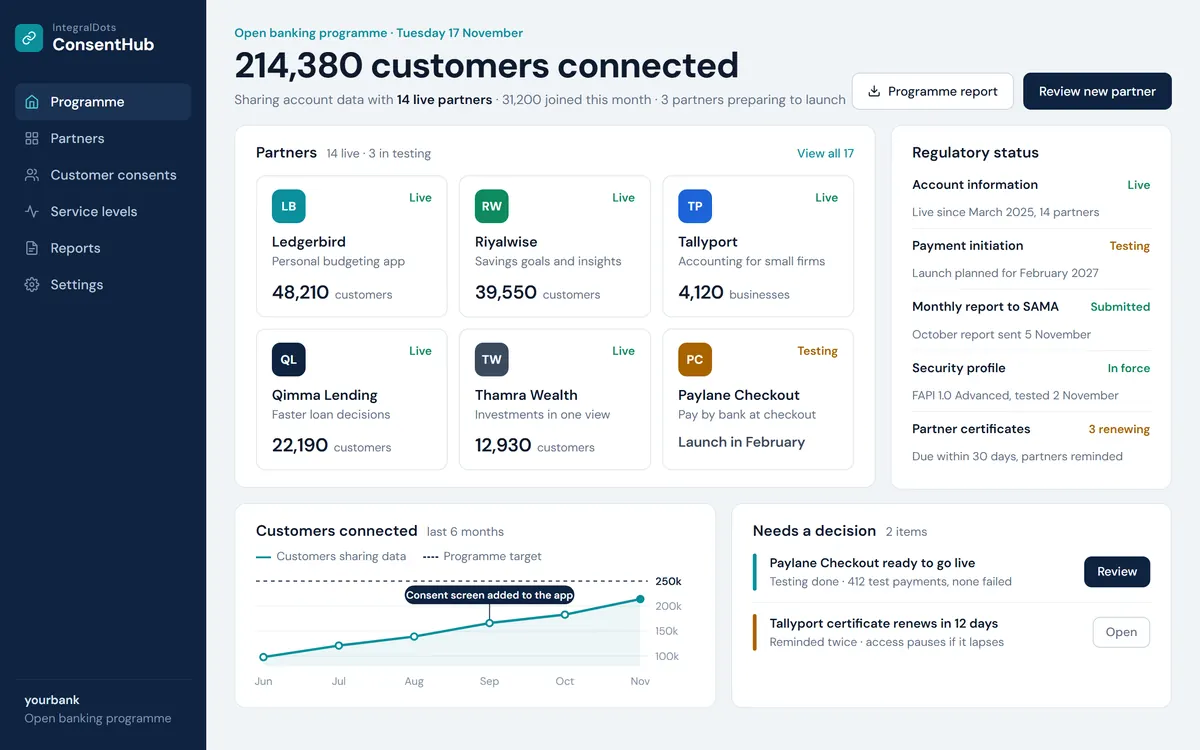
ConsentHub Open banking platform
TPP onboarding, consent lifecycle and FAPI-secured account and payment APIs under the SAMA framework.
Explore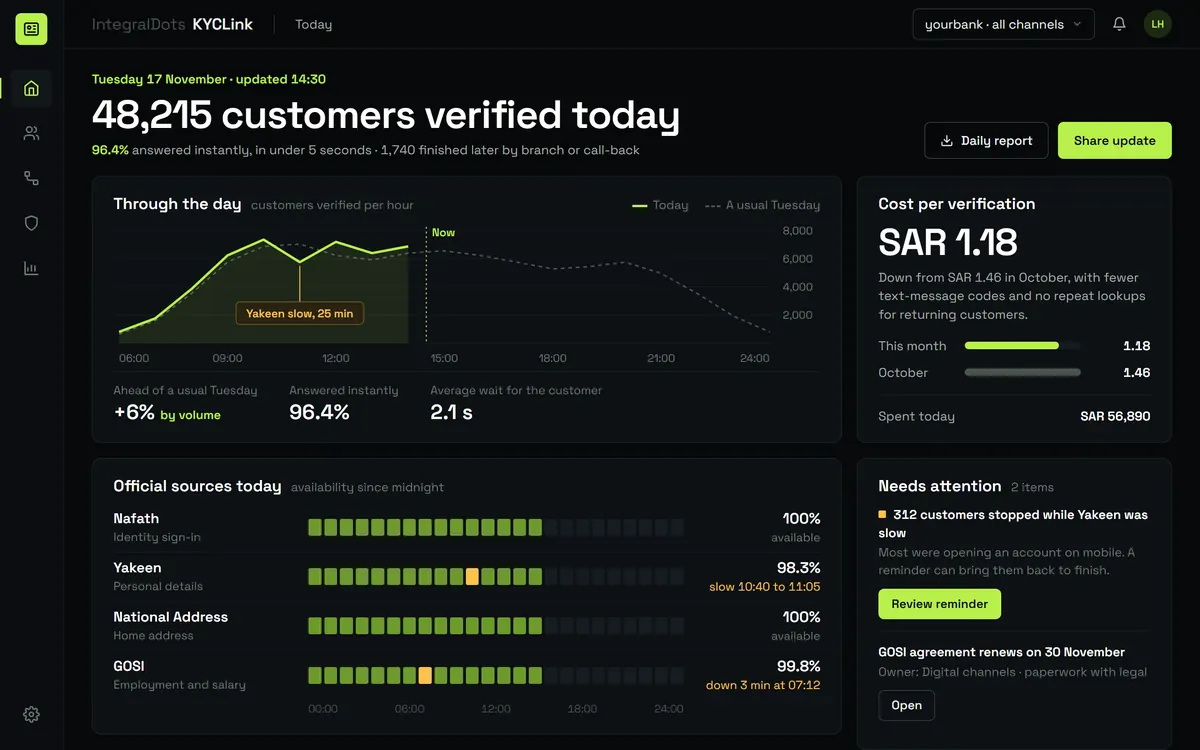 Identity
KYCLink Identity and KYC gateway
One gateway for identity verification and KYC checks against national data sources.
Explore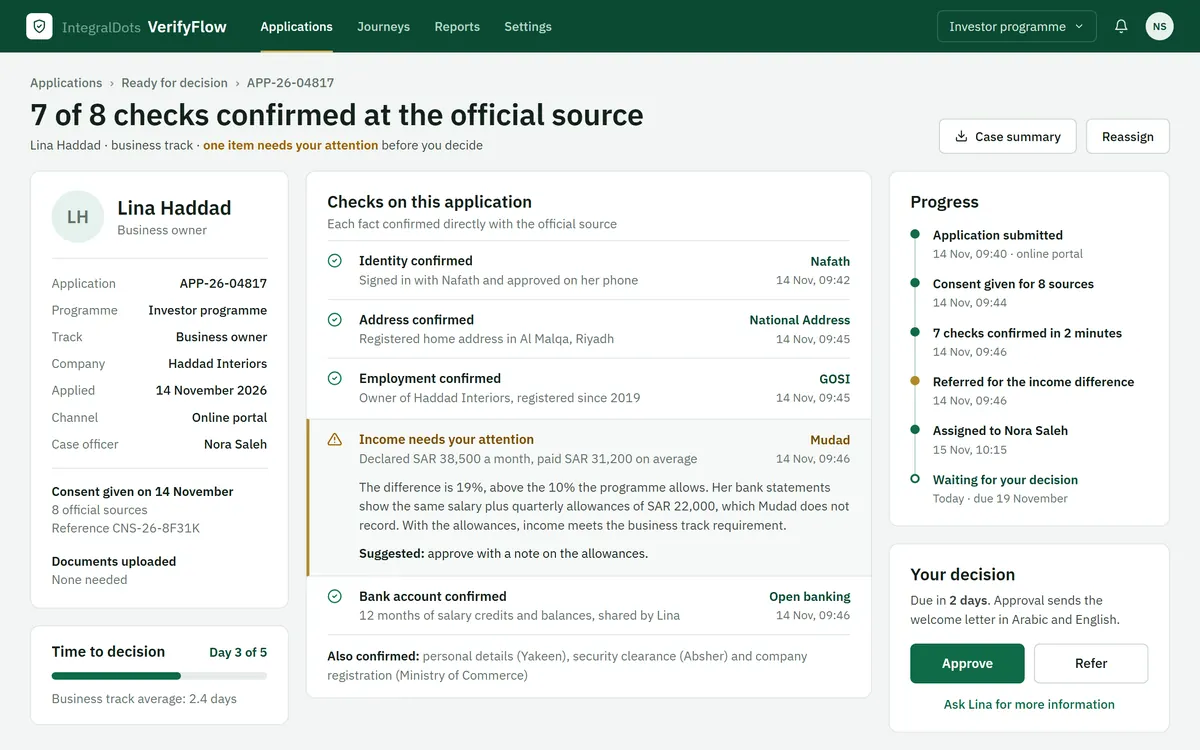 Digital government
VerifyFlow Verified onboarding platform
Digital onboarding journeys built on verified national identity and data.
Explore